






I think burnout has come knocking on most people’s doors in the last two years and its left lots of us wondering just how to recover from burnout so it stops taking over your life.
Burnout used to be just a workplace thing, but it’s broadened out in recent years to parental burnout, creative burnout, millennial burnout and now pandemic burnout.
The truth is burnout can cause so many problems in our lives that it leaves us desperate for the answer to the question “how to recover from burnout”
Earlier this year (2021), I asked my audience what they wanted me to cover in my next webinar and an overwhelming amount said burnout. So my webinar ‘Bye Bye Burnout, Hello Breakthrough’ was born, and I’ve decided to distill the key points here for anyone that missed it and has found their way to my blog (hello! welcome, glad to see you here).
I’m going to go in straight with the key image and concept from that webinar that can help you.
I present to you – The Exhaustion Funnel.
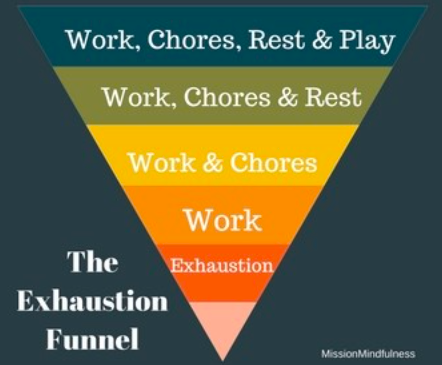
The Exhaustion Funnel was created by Professor Marie Åsberg, a burnout expert.
She’s quite blunt and describes the funnel as ‘The Process of Not Caring for Ourselves’.
Ouch.
I do see where she’s coming from…BUT, I know burnout is more complex than that and it’s no use blaming the poor burnout person.
What is useful, I find, is if you sense yourself creeping towards burnout, to use this image as a jumping off point and ask:
What has become a chore that wasn’t a chore before?
As stress increases in our lives, so does our sensitivity to stress.
Sometomes knowing how to prevent burnout can be key to avoiding it otherwise what didn’t annoy you before can send you into overdrive or collapse.
So has something that used to be a pleasure or a relaxer (eg. planning weekend fun or cooking) become a chore to you?
If so, can you ask for help?
Try not guilt trip yourself for not doing it the ‘fun’ chore. Instead, add innovation or play to it to help you.
For example, I know texting back to friends has become a chore for some.
Can you switch to voice notes to make it less chore-like and just easier to do?

What has become work that wasn’t before?
Professor Åsberg goes on to raise our awareness about where work ends in these modern times of doing it all:
“The brain, cannot differentiate between employment and other work-like tasks, such as planning a lot of activities in your spare time, having a competitive hobby, or updating social media.”
Doesn’t that quote really make you stop and think?! Like, yeah, how does my brain know I’m not working any more?
I know a lot of people may shut their laptops but keep thinking about work.
Or others who have their side hustle or intense hobbies that may have been a release or creative relief pre-pandemic, but now it may be the cause of more stress.
So what can you do to signal rest to your brain? What truly works for you? What will help you recover from burnout and get you back to feeling your best?
How can I add more play into my life?
I can’t remember who said this, I want to say Simon Sinek. But the quote goes something like this:
“You’re not burnout because you’re doing too much, you’re burnout because you’re not doing enough of what makes you happy”
Which is why there’s a case for adding play, as counter-intuitive as it may seem.
The beauty of play is that it can be incorporated into work hours.
Play with your colleagues. Listen to some guaranteed hoots during your lunch break or walk.
I love standup comedy and also thoroughly enjoy bloopers or ‘best of Graham Norton’ bits on YouTube. Try it.
Ask for feedback
Another major reason for burning out is because we feel unappreciated.
When burnout was first noted, in the 1970s, it was also nicknamed ‘compassion fatigue’. This was primarily because it was first observed in the caring sector (nurses, social services and teachers).
But even if you don’t fall into those sectors chances are you’re giving more than you’re receiving back.
And what do you want to receive back?
Or rather, what do you need to receive back in order to be the antidote to burnout?
Feedback.
Preferably positive.
A thank you. An acknowledgment that your work is being seen and appreciated.
Maybe you work in a company where the managers are overstretched too and they’re forgetting to appreciate you.
Don’t be shy to remind them. Ask them for feedback, and prompt them.
It might just be the soothing balm your soul was asking for.
If you liked this blog post, then subscribe to my newsletter to get more of these.
Paragraph
Paragraph

Be the first to comment